
Pervasive staffing shortages have led some law enforcement leaders to resort to lowering hiring standards and cutting corners in background investigations and field training simply to fill positions and get “boots on the ground.” These compromises in hiring standards carry serious consequences, as may well be evidenced by the many 2025 headlines highlighting the damage caused by apparent failures in properly vetting new officers.
In May of 2025, a rookie officer with the San Francisco Police Department was fired following his arrest for his involvement in a drunk driving accident less than 48 hours after graduating from the police academy.[1] In June, a probationary Providence Police Department officer, who began working for the department 9 months before, was fired after being arrested on multiple narcotics charges off-duty.[2] In July, four Atlanta Police Department recruits were dismissed after being involved in an off-duty altercation resulting in one of the officers allegedly discharging a firearm after eluding police custody outside a bar.[3]
In September, a newly-hired Walbridge, Ohio officer was terminated for being intoxicated on-duty. This officer had been hired despite multiple past incidents of misconduct involving alcohol while employed as an officer in nearby Toledo.[4] One local outlet reported that the mayor of Walbridge stated “he was unaware of past issues…with TPD,” and said he “had confidence in the background check conducted by Walbridge police personnel at the time.”[5] And over the course of just 8 days in late October and early November of 2025, two probationary officers were fired by the San Antonio Police Department as a result of unrelated off-duty criminal charges.[6]
These stories point to misconduct, both on-duty and off-duty, that occurred so early in an officer’s career that burnout—cumulative stress related to the job—seems to be an implausible explanation. Common sense dictates that, if an individual cannot manage to get through the academy and the probationary process without making headlines for misconduct, something was likely missed in the hiring process.
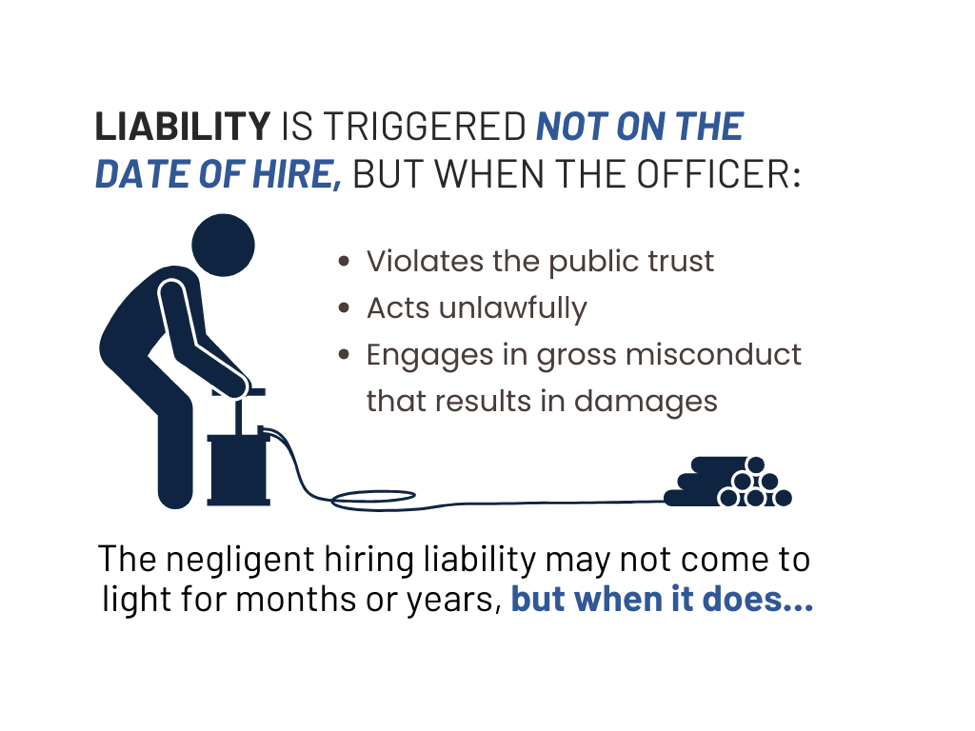
Negligent hiring is a foundational issue affecting all facets of law enforcement operations, both in the short term and over time. Often, the greatest opportunity to mitigate liability across an officer’s career is presented to police leaders during the hiring phase, with particular emphasis on thorough background investigations and field training.
The 2025 stories referenced above come in the wake of recommendations of a Department of Justice (DOJ) report in October of 2023 which urged law enforcement leaders to “modernize eligibility requirements.”[7] These “modernization” recommendations included removing barriers to entry such as physical fitness, past drug use, ability to pass a written test, past criminal offenses, and much else.[8] In other words, the DOJ report from the previous administration formally touted what too many agencies have adopted informally—lowering hiring standards to fill open officer positions.
While there are undoubtedly agencies that need to reevaluate some of their eligibility requirements—such as those pertaining to maximum age limits, college credit hours attained, or other requirements which seem to bear little or no relationship to an applicant’s character, competence, or integrity—the eligibility items highlighted by this former DOJ report implied that now is the time to lower standards, hire “warm bodies,” and deal with the fallout later. Law enforcement leaders should, instead, follow their ethical compasses and apply common sense. They should look to their own experiences within their agencies, and to the history of modern American policing, and subsequently reject this short-sighted and unethical philosophy of rushed hiring and lowered standards.
At this moment, the law enforcement profession, and the citizens who depend on it, need agency leaders to meet the ethical challenge of resisting the temptation to hire unqualified applicants. In the long run, these applicants have the potential to inflict tremendous damage on agencies, the profession, and the communities that these agencies serve.
Neither officers nor the public benefit from unqualified law enforcement hires who undermine the profession instead of advancing its duty to protect and serve. The short-term accomplishment of swearing in more recruits and announcing their arrival to communities eager for more police services, pales in comparison to the long-term damage caused by hiring people right now instead of ensuring that they are hired the right way. Through careful reflection on past errors, awareness of common hiring pitfalls, and an understanding of the enduring consequences of negligent hiring, agency leaders can maintain professional integrity while avoiding harm to their agencies and the communities they serve.
You Cannot Outsource Negligent Hiring Liability
In recent years, many states have attempted to assist local law enforcement agencies in identifying officers with past misconduct issues in an effort to prevent bad actors from moving from agency to agency and being hired without proper regard for their past actions. The legislation passed in these states includes certification and de-certification processes, increased funding and resources for state-wide accreditation bodies, as well as mandates for local agencies to better communicate with one another in service of more thorough background investigations for lateral hiring.
Illinois is one of the many states that has passed legislation in recent years aimed at preventing the hiring of officers with checkered histories.[9] But the reality remains that local law enforcement agencies are still ultimately responsible for engaging in legally and ethically defensible hiring practices.
This local responsibility in hiring officers, and the consequences of failures in legally and ethically defensible hiring practices, were brought to national attention following the fatal shooting of Sonya Massey in 2024. Massey, a mentally ill, unarmed woman, was shot and killed by a Sangamon County Sheriff’s deputy who was hired in spite of past misconduct issues in his personal life and as a law enforcement officer at other Illinois agencies. The fatal shooting occurred less than 4 miles from the Illinois State Capitol where the aforementioned legislation was passed.[10]
The now-former Sheriff of Sangamon County, who eventually stepped down in the wake of Massey’s death and subsequent evidence of the deputy’s checkered past in law enforcement, defended the deputy’s hiring in a local news interview as follows:
“There is absolutely nothing in his background that would decertify him from working in law enforcement,” Campbell said. “The State of Illinois, the State Standards Board had certified him six times over and over and over again to continue working with law enforcement. There was nothing that we could have predicted.”[11]
But in February of 2025, Sangamon County settled a lawsuit filed by the family of Sonya Massey for damages in the amount of $10 million. The county and its sheriff’s office, whose leaders had hired and deployed the deputy to the scene were liable for the incident – not the State of Illinois, its law enforcement accrediting body, or any other outside entity tasked with assisting local police leaders in their hiring decisions. [12]
Hopefully, state accreditation bodies will continually improve in assisting individual agencies in the hiring process—particularly as it pertains to hiring laterals from within that state. However, it is clear that when negligent hiring practices lead to the deployment of individuals unfit for the job, the fallout from their subsequent negligence or misconduct falls first and foremost on the agencies that hired them, the agency name which is displayed on the badges that they wear, and not the state body that has certified them.
If We Are Hiring Applicants Without Leaving the Office—
We Are Doing Something Wrong
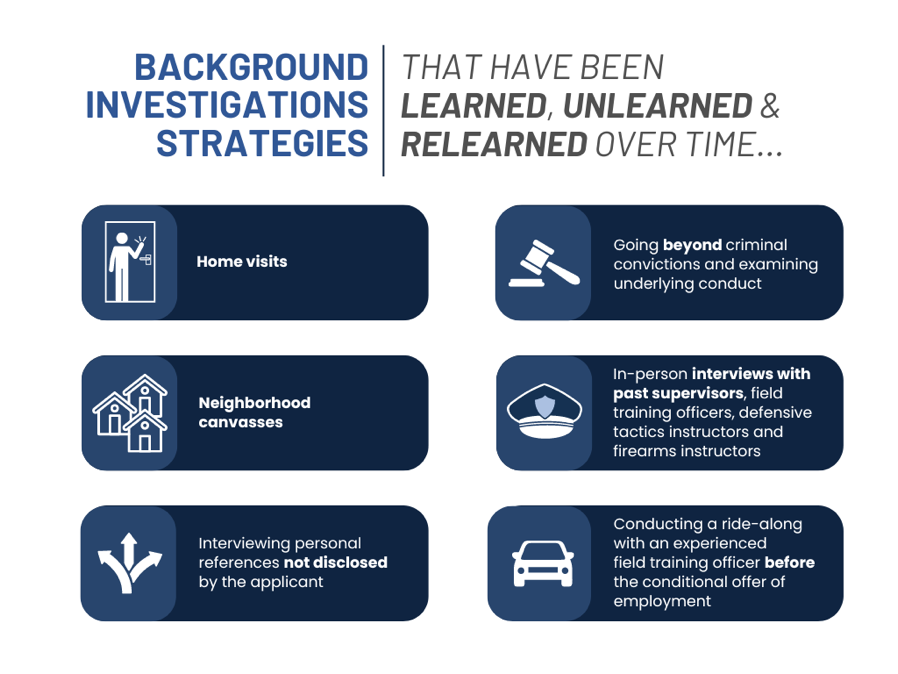
Technological advancements have undoubtedly made it possible for background investigators to disqualify applicants with increased efficiency and decreased time commitment. Many dishonest statements on a personal history record form can be readily identified by checking various databases online. Social media activity can be checked for blatantly disqualifying conduct without the necessity of an investigator leaving the office. But these advancements tend only to assist investigators in disqualifying candidates, rather than approving them for hire. These tools are generally limited to identifying automatic disqualifiers and the kind of commonsense disqualifiers that are obvious to anyone with internet access.
The real work for background investigators, which must be done before approving a candidate, requires an out-of-office-experience. Technological advancements have not replaced traditional methods including, but not limited to, a home visit, neighborhood canvass, and interviews with past supervisors, FTOs, and firearms instructors.
Law enforcement leaders should be prepared to defend their hiring practices by describing their efforts, outside of minimal in-office background checks, to identify possible character, integrity, and competence issues revealed by past conduct. This is particularly true in light of the financial and public trust costs associated with bad hires, when compared to the costs associated with a thorough background investigation.
About the Author
Matt Dolan, J.D.
Matt Dolan is a licensed attorney who specializes in training and advising public safety agencies in matters of legal liability, risk management, and ethical leadership. His training focuses on helping agency leaders create ethically and legally sound policies, procedures, and practices as a proactive means of minimizing liability and maximizing agency effectiveness.
A member of a law enforcement family dating back three generations, he serves as both Director and Public Safety Instructor with Dolan Consulting Group.
In December of 2024, he published his first book, Police Liability: A Guide for Law Enforcement Leaders of All Ranks.
His training courses include Background Investigations in Law Enforcement, Supervisor Liability for Law Enforcement, and Internal Affairs: Legal Liability and Best Practices.
Disclaimer: This article is not intended to constitute legal advice on a specific case. The information herein is presented for informational purposes only. Individual legal cases should be referred to proper legal counsel.
References
_____________________________________________
[1] Jonah Owen Lamb and Garrett Leahy, “Rookie cop fired after high-speed DUI crash,” San Francisco Standard, May 20, 2025. Accessed December 19, 2025 at: https://sfstandard.com/2025/05/20/rookie-cop-fired-after-high-speed-dui-crash/
[2] Gino DeAngelis, “Probationary Providence Police officer arrested on multiple narcotics charges,” ABC 6 Providence News, June 27, 2025. Accessed December 17, 2025 at: https://www.abc6.com/probationary-providence-police-officer-arrested-on-multiple-narcotics-charges/
[3] Dan Raby and Aungelique Proctor, “Atlanta police recruits dismissed after altercation at East Point business, officials say,” Fox 5 Atlanta News, July 24, 2025. Accessed December 19, 2025 at: https://www.fox5atlanta.com/news/atlanta-police-recruits-dismissed-altercation-east-point-business
[4] Melissa Andrews and Brian Dugger, “Fired Walbridge police officer previously resigned from Toledo after 3 separate incidents involving alcohol, records show,” WTOL 11 News, September 24, 2025. Accessed December 19, 2025 at: https://www.wtol.com/article/news/investigations/11-investigates/fired-walbridge-officer-resigned-toledo-alcohol-incidents-ervin/512-7d1839e5-4bcb-4352-a8cb-8d4560b44466
[5] Ibid.
[6] Dillon Collier and Joshua Saunders, “SAPD probationary officers fired after drunken incident days apart,” KSAT News, November 24, 2025. Accessed December 26 at: https://www.ksat.com/news/ksat-investigates/2025/11/24/sapd-probationary-officers-fired-after-drunken-incidents-days-apart/
[7] Bureau of Justice Assistance and Office of Community Oriented Policing Services, Recruitment and Retention for the Modern Law Enforcement Agency: Revised (Washington, DC: Office of Community Oriented Policing Services, 2023).
[8] BJA and COPS, Recruitment and Retention for the Modern Law Enforcement Agency, 4.
[9] NBC Chicago, “Here’s What to Know About Illinois’ SAFE-T Act and the NEW Changes Coming,” NBC Chicago News, December 2, 2024. Accessed December 23, 2024 at: https://www.nbcchicago.com/news/local/heres-what-to-know-about-illinois-safe-t-act-and-the-new-changes-coming/3011535/
[10] Sangamon County Sheriff’s Office Press Release, “Illinois State Police Announce Investigation into Officer Involved Shooting Continues,” Sangamon County Sheriff’s Office, July 10, 2024: Accessed on December 30, 2024 at: https://sangamonil.gov/departments/s-z/sheriff/sonya-massey-information#:~:text=On%20July%206%2C%202024%20at,deceased%20at%20an%20area%20hospital.
[11] Danny Connolly, “Sheriff Campbell Planning Policy Changes After Deputy Shooting of Sonya Massey,” WCIA News, August 1, 2024. Accessed December 23, 2024 at: https://www.wcia.com/news/sheriff-campbell-planning-policy-changes-after-deputy-shooting-of-sonya-massey/
[12] Janelle Griffith, “$10 million settlement in Sonya Massey shooting case gets final approval,” NBC News, February 12, 2025. Accessed December 19, 2025 at: https://www.nbcnews.com/news/us-news/10-million-settlement-sonya-massey-shooting-case-gets-final-approval-rcna191825
