
Law enforcement leaders frequently complain that they and their agencies suffer significant legal liability consequences in the realm of labor and employment law when they do the right thing. They argue that they are essentially punished in court for ethically defensible disciplinary actions. In this context, the right thing can be defined as disciplining, choosing not to promote, or even terminating an officer who engages in frequent and/or extremely severe acts of misconduct or negligence.
I have heard many of these complaints myself from supervisors over the years who express dismay at the fact that an officer was ultimately reinstated to their department after being fired for reasons that seem painfully obvious and justified, or that an officer received a financial settlement following a termination that the officer earned through inexcusable actions. By recognizing the misconduct and promptly dismissing the officer, considering the foreseeable harm that continued employment could bring to the department and to the public, they argue, aren’t supervisors and their agencies simply being punished in these cases for doing the right thing? Should we just file this under the old adage that “No Good Deed Goes Unpunished?”
I tend to take these sorts of complaints at face value, as I am in no position to doubt the truth or sincerity of a police leader who asserts that firing an officer was the right thing to do for the safety of the officer, that of the other department members, and the public at large because the officer’s inability or unwillingness to meet professional standards was going to get someone hurt. And, yes, in some cases, I would agree that a city council or other elected body may agree to settle a frivolous lawsuit brought by a former employee in a way that is ill-advised and unreasonable. But there are many cases in which supervisors have succeeded in doing the right thing but have fallen short in doing it the right way.
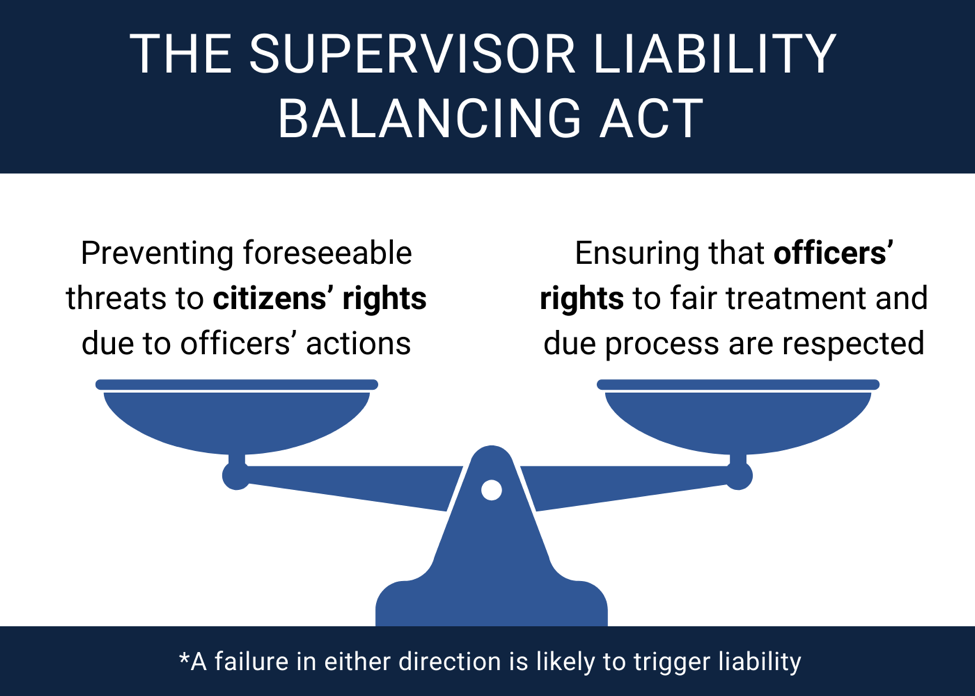
This fundamental challenge for supervisors to do the right thing and do it the right way—in a way that is ethically and legally defensible in light of the officer’s rights to due process and equal treatment—is crucial to successful personnel management in law enforcement. One could certainly argue that police leaders are more than half the way there when they are inspecting what they expect, having courageous conversations, and confronting misconduct without unnecessary delay. But they must also confront that misconduct in a way that does not appear to be discriminatory, retaliatory, or otherwise unfair or unjust. This difficult undertaking of personnel management is what I have come to refer to as the Supervisor Liability Balancing Act.
The Supervisor Liability Balancing Act can be extremely challenging in practice, but the concept is fairly simple. Supervisors—particularly those involved in decisions related to discipline, promotions, and terminations—must demonstrate due diligence in (1) preventing foreseeable threats to citizens’ rights due to employee misconduct and (2) ensuring that employees’ rights to fair treatment and due process are respected.
A failure in either direction—whether failing to prevent foreseeable harm to the public or failing to treat employees fairly in the process of investigating allegations of wrongdoing and acting upon those findings—can result in substantial liability in the court of law and the court of public opinion.
To give a more concrete sense of the Supervisor Liability Balancing Act, it is helpful to take a look at both sides of the coin in the form of recent public settlements and verdicts.
Final tally: Chicago taxpayers to spend $126.8M to resolve lawsuits tied to disgraced ex-Sgt. Ronald Watts, on September 25, 2025. Woman handcuffed in police car hit by freight train reaches $8.5M settlement on June 5, 2024. Seattle reaches $29M settlement with family of student killed by speeding officer, on February 11, 2026. These headlines are recent snapshots of legal liability stemming from alleged failures of police leaders to properly select, train, supervise, and discipline officers so as to prevent foreseeable threats to the public in the form of police misconduct in the field or under the color of law.
On the other side of the Supervisor Liability Balancing Act, these headlines are snapshots of legal liability stemming from alleged failures of police leaders to hire, promote, and discipline officers in a way that reflects fair and equal treatment, regardless of an officer’s race, religion, gender, or other factors prohibited by law and ethical duty. Controversial Houston police officer reinstated with backpay, on September 29, 2025.[i] Vallejo PD Whistleblower Settles Lawsuit for Close to $1 Million, on September 13, 2023.[ii] Folsom approves settlement for third ex-police officer who alleged racism, on January 14, 2026.[iii] Detective Gets $730k in Settlement after Accusing N.J. Town, Police Chief of Discrimination, on April 15, 2022.[iv]
It is only by navigating the Supervisor Liability Balancing Act successfully that police leaders can avoid the kind of damage reflected in the headlines above, both in the court of law and in the court of public opinion. Law enforcement leaders are tasked with holding officers accountable and doing so without sacrificing officers’ rights to due process and fair treatment in the process.
About the Author
Matt Dolan, J.D.
Matt Dolan is a licensed attorney who specializes in training and advising public safety agencies in matters of legal liability, risk management, and ethical leadership. His training focuses on helping agency leaders create ethically and legally sound policies, procedures, and practices as a proactive means of minimizing liability and maximizing agency effectiveness.
A member of a law enforcement family dating back three generations, he serves as both Director and Public Safety Instructor with Dolan Consulting Group.
In December of 2024, he published his first book, Police Liability: A Guide for Law Enforcement Leaders of All Ranks.
His training courses include Supervisor Liability for Law Enforcement, Background Investigations in Law Enforcement, and Internal Affairs: Legal Liability and Best Practices.
Disclaimer: This article is not intended to constitute legal advice on a specific case. The information herein is presented for informational purposes only. Individual legal cases should be referred to proper legal counsel.
References
[1] Heather Cherone, “Final tally: Chicago taxpayers to spend $126.8M to resolve lawsuits tied to disgraced ex-Sgt. Ronald Watts,” WTTW PBS News, September 25, 2025. Accessed February 20, 2026 at: https://news.wttw.com/2025/09/25/final-tally-chicago-taxpayers-spend-1268m-resolve-lawsuits-tied-disgraced-ex-sgt-ronald.
[2] Praveena Somasundaram, “Woman handcuffed in police car hit by freight train reaches $8.5M settlement,” Washington Post, June 5, 2024. Accessed February 20, 2026 at: https://www.washingtonpost.com/nation/2024/06/05/colorado-police-car-train-crash/.
[3] Mike Carter, “Seattle reaches $29M settlement with family of student killed by speeding officer,” Seattle Times, February 11, 2026. Accessed February 20, 2026 at: https://www.seattletimes.com/seattle-news/law-justice/seattle-reaches-29m-settlement-with-family-of-student-killed-by-speeding-officer/.
[4] Joel Eisenbaum, “Controversial Houston police officer reinstated with backpay,” Click 2 Houston News, September 29, 2025. Accessed February 20, 2026 at: https://www.click2houston.com/news/local/2025/09/30/controversial-houston-police-officer-reinstated-with-backpay/.
[5] Melanie Woodrow, “Vallejo PD Whistleblower Settles Lawsuit with City for Close to $1 Million,” ABC7 KGO News, September 13, 2023. Accessed March 1, 2024 at: https://abc7news.com/vallejo-police-department-whistleblower-settlement-badge-bending-lawsuit/13780117/.
[6] Ishani Desai, “Folsom approves settlement for third ex-police officer who alleged racism,” Sacramento Bee, January 14, 2026. Accessed February 20, 2026 at: https://www.sacbee.com/news/local/article314323423.html.
[7] Steven Rodas, “Detective Gets $730K in Settlement after Accusing N.J. Town, Police Chief of Discrimination,” NJ.com, February 15, 2023. Accessed March 1, 2024 at:https://www.nj.com/camden/2022/04/detective-gets-730k-in-settlement-after-accusing-nj-town-police-chief-of-discrimination.html#:~:text=A%20lawsuit%20filed%20by%20a,NJ%20Advance%20Media%20has%20learned.
