Marijuana Declassification and Off-Duty Use by Police Officers


Last month, President Trump signed an executive order reclassifying marijuana from a Schedule I drug to a Schedule III drug. This means that, under federal law, marijuana will now be treated with the same or lesser degree of restriction as drugs such as Adderall, Ritalin, anabolic steroids, and testosterone.

In past years, the high likelihood of declassification has led some law enforcement leaders to consider the ramifications of such a change to their current prohibitions on off-duty marijuana use by officers. Now that the declassification is imminent, it is vital that police leaders, particularly those in states where recreational marijuana is legal, determine how to approach current policies prohibiting marijuana use by officers.

Agency leaders should act now, in cooperation with local elected officials and the community that they serve, to: (1) determine whether off-duty marijuana use will continue to be prohibited in the face of federal declassification; (2) define the articulable job-related rationale for why this prohibition is necessary; and (3) create fair and legally defensible testing and screening policies.


The Impact of Federal Declassification on Law Enforcement Agency Policies

Marijuana, along with commonly used substances such as Ambien and Xanax, is a controlled substance, meaning that legal gun ownership requires that all citizens —including law enforcement hires—complete an ATF Form 4473 affirming that they are not an unlawful user of a controlled substance, including marijuana.[1]  As of last week, marijuana was a Schedule 1 drug, along with drugs including heroin and LSD.[2] Law enforcement agencies across the country often cite federal law in prohibiting off-duty marijuana use—most notably, under 18 U.S.C. § 922(g)(3), which states that no person “who is an unlawful user of or addicted to any controlled substance” may “possess . . . or . . . receive any firearm or ammunition.”[3]

However, the new declassification of the drug under federal law now brings into question the practicality of relying on gun ownership restrictions that would, in theory, apply to drugs such as ADHD medications and testosterone.

This legal development should not be entirely surprising in light of the continued increase in support for marijuana legalization across the country, and across the political spectrum. A recent Gallup Poll found that 68% of Americans are in favor of marijuana legalization.[4] And these polls indicate that support is increasing among Democrats, Independents and Republicans.

The tide of public opinion in favor of legalization does not mean that there are not any detractors—as evidenced by voters’ rejection of proposed legalization in North Dakota, South Dakota, and Arkansas. Despite 68% support for marijuana decriminalization, Americans are evenly split in their views about marijuana’s effect on society, with 49% considering it positive and 50% negative.[5] Many public health experts and scientists also continue to raise concerns about long-term marijuana use and cognitive ability.[6]

Your community may be strongly opposed to the idea of law enforcement officers using marijuana. But what this national trend does clearly indicate is that agency leaders will need to gauge community support for off-duty marijuana prohibitions and clearly articulate how this off-duty use impacts the public trust, such that regulating it is job-related and legally defensible. 


Defining the Nexus Between Off-Duty Marijuana Use and On-Duty Work

Even if recreational marijuana is legal in your jurisdiction, that does not necessarily mean that law enforcement officers cannot be held to a standard of conduct that is higher than what is the bare minimum of legal behavior. For well over a century, courts have recognized that police officers are routinely prohibited from engaging in behavior that would be otherwise lawful or even constitutionally protected. As far back as 1892, for instance, the Massachusetts Supreme Court held that, “[t]he petitioner may have a constitutional right to talk politics, but he has no constitutional right to be a policeman.”[7]

“Conduct Unbecoming an Officer” standards exist, in large part, due to the recognition that the sensitive nature of police work requires officers to be held to a higher standard than the general public. Social media posts, inflammatory political activity, and countless other legally protected off-duty actions can, and do, result in legally defensible discipline—up to and including termination—when the unique authority of a law enforcement officer’s job responsibilities is taken into account.

For many law enforcement agencies, however, federal declassification will require a specific articulation of marijuana prohibition that has not been necessary in the past.  What seemed obvious 20 years ago is no longer so obvious, in light of legalization and cultural normalization.  Many law enforcement leaders point to the difficulty in testing for marijuana impairment—as opposed to alcohol impairment—as rationale for prohibiting its use.  But the simple fact that something is more difficult to test or detect seems unlikely to be a reasonable justification for prohibition in and of itself. 

Agency policies will need to clearly define how off-duty marijuana use is substantially detrimental to an individual’s ability to perform that individual’s duties and/or is substantially disruptive to agency operations. 


Practical Considerations

As we noted in a past article on trends in police staffing, the pool of qualified applicants for law enforcement positions is not only shrinking, but this problem shows no signs of turning around in the coming years.[8]  This means that police leaders will be required to make difficult decisions regarding recruiting and retention, in light of the realities of available applicants, in the years ahead.  

As we described in detail in the aforementioned article, it seems extremely unlikely that many agencies will be capable of providing the same law enforcement services that they have in the past if they continue staffing according to existing personnel policies. Is off-duty marijuana use similar to visible tattoos or beards—something once thought to be taboo for officers that has become permissible in light of new cultural norms? Are citizens unconcerned with whether an officer uses marijuana off-duty, if the alternative to accepting that behavior could mean increased wait times when calling 911 and a decreased police presence in their community? Or is off-duty marijuana use a more permanent red line issue for maintaining community support? This is a question that may well be answered differently for different jurisdictions. 

For those agencies that seek to take measures to minimize the risk of on-the-job impairment without instituting outright use prohibitions, the Federal Aviation Administration (FAA) approach to alcohol use for airline pilots offers a potential template. The “Bottle to Throttle” policy prohibits airline pilots from consuming alcohol within 8 hours of flying.[9] Many airlines have increased that timeframe to further decrease the likelihood that significant amounts of alcohol are still in a pilot’s system while on-duty.[10] Law enforcement agencies may want to consider a marijuana use policy similar to the “Bottle to Throttle” rule if they choose to place clear limits on off-duty use without opting for outright prohibition.

For those law enforcement leaders who will maintain a prohibition on off-duty marijuana use, it is necessary to lay out the community expectations and/or medical evidence of long-term impairment upon which the decision is based.  It is also necessary to consider the widespread use of CBD, which is widely legal and advertised as an alternative to traditional pharmaceutical treatment for a variety of ailments that contains less than 0.3% THC. CBD products promise to treat ailments without the “high” associated with heightened THC. However, many drug testing methods currently in use can result in a positive test when the only product used by the officer was CBD.[11] Agency policies should also address the use of CBD, in addition to the use of marijuana. Drug recognition techniques will likely need to be an integral part of drug testing and evidence of impairment may need to exceed a positive test result alone.


Conclusion

As law enforcement agencies grapple with how to respond to the federal declassification of marijuana, it seems clear that now is the time to develop policies and procedures in cooperation with the communities they serve.  Agency failures to ensure coherent policies concerning off-duty marijuana use are likely to see substantial discord and confusion if they are caught completely unprepared.

Views of personal marijuana use—whether from medical experts or the community at large—will continue to be contentious, and no attorney can ultimately answer these policy questions for your agency without understanding your particular community and agency priorities.  But the conversations around policy and procedure should begin now so that your agency is prepared to make legally defensible personnel decisions now that federal declassification is becoming a reality.


About the Author

Matt Dolan, J.D.

Matt Dolan is a licensed attorney who specializes in training and advising public safety agencies in matters of legal liability, risk management, and ethical leadership.  His training focuses on helping agency leaders create ethically and legally sound policies, procedures, and practices as a proactive means of minimizing liability and maximizing agency effectiveness. 

A member of a law enforcement family dating back three generations, he serves as both Director and Public Safety Instructor with Dolan Consulting Group.

In December of 2024, he published his first book, Police Liability: A Guide for Law Enforcement Leaders of All Ranks.

His training courses include Background Investigations in Law Enforcement, Supervisor Liability for Law Enforcement, and Internal Affairs: Legal Liability and Best Practices.


Disclaimer: This article is not intended to constitute legal advice on a specific case.  The information herein is presented for informational purposes only.  Individual legal cases should be referred to proper legal counsel.


References
________________________________________

[1] 18 United States Code, Subsection 922(g)(3). 

[2] U.S. Controlled Substances Act. 1971. Public law 91-513, Statutes at Large 84 Stat. 1236 a.k.a. 84 Stat. 1242.

[3] 18 U.S.C. § 922(g)(3).

[4]  Megan Brenan, “Support for Legal Marijuana Inches Up to New High of 68%.” Gallup News, November 09, 2020. Accessed December 30, 2025: https://news.gallup.com/poll/323582/support-legal-marijuanainches-new-high.aspx    

[5] Lydia Saad, “Americans Not Convinced Marijuana Benefits Society.” Gallup News. August 16, 2022. Accessed December 30, 2025: https://news.gallup.com/poll/396893/americans-not-convinced-marijuanabenefits-society.aspx

[6]  See, for example: Hall, W., Lynskey M. (2016). Long-term marijuana use and cognitive impairment in middle age. JAMA: Journal of the American Medical Association: Internal Medicine, 176(3), 362–363; Hernandez, Caesar M., Caitlin A Orsini, Shelby L Blaes, Jennifer L Bizon, Marcelo Febo, Adriaan W Bruijnzeel, & Barry Setlow. (2022). Effects of repeated adolescent exposure to cannabis smoke on cognitive outcomes in adulthood. Journal of Psychopharmacology, 35(7), 848-863; Meier, Madeline H., Avshalom Caspi, Annchen R. Knodt, Wayne Hall, Antony Ambler, Hona-Lee Harrington, Sean Hogan, Renate M. Houts, Richie Poulton, Sandhya Ramrakha, Ahmad R. Hariri, & Terrie E. Moffitt. (2022). Long-term cannabis use and cognitive reserves and hippocampal volume in midlife. American Journal of Psychiatry, 179(5), 362-374; Morrison, Paul D., & Robin M. Murray. (2022). Cannabis points to the synaptic pathology of mental disorders: how aberrant synaptic components disrupt the highest psychological functions. Dialogues in Clinical Neuroscience, 22(3), 251-258; Salmanzadeh, Hamed, S. Mohammad Ahmadi-Soleimani, Narges Pachenari, Maryam Azadi, Robert F. Halliwell, Tiziana Rubino, & Hossein Azizi. (2020). Adolescent drug exposure: A review of evidence for the development of persistent changes in brain function. Brain Research Bulletin, 156, 105-117.

[7] McAuliffe v. Mayor of New Bedford, 155 Mass. 216, 220 (1892).

[8] Dolan, Matt, & Richard R. Johnson. (2022) Weathering the Storm in Police Staffing? Raleigh, NC: Dolan Consulting Group. Accessed December 30, 2025: https://www.dolanconsultinggroup.com/news/weathering-the-storm-in-police-staffing/

[9]  Hetter, Katia, & Marnie Hunter. “What are the alcohol rules for US airline pilots?” CNN, August 1, 2019. Accessed: https://www.cnn.com/travel/article/airline-pilot-alcoholpolicies/index.html

[10] Ibid.

[11] Booth, Jessica & Jessica Cho, M.D. “Does CBD Show Up on a Drug Test?” Forbes, June 16, 2022, Accessed December 30, 2025: https://www.forbes.com/health/body/does-cbd-show-up-on-a-drugtest/#:~:text=On%20cbdMD’S%20Website,Can%20CBD%20Use%20Lead%20to%20a%20Positive%20Result%20on%20a,uncommon%20 as%20you%20might%20think.  

Negligent Hiring Liability for Law Enforcement in 2026


Pervasive staffing shortages have led some law enforcement leaders to resort to lowering hiring standards and cutting corners in background investigations and field training simply to fill positions and get “boots on the ground.” These compromises in hiring standards carry serious consequences, as may well be evidenced by the many 2025 headlines highlighting the damage caused by apparent failures in properly vetting new officers.

In May of 2025, a rookie officer with the San Francisco Police Department was fired following his arrest for his involvement in a drunk driving accident less than 48 hours after graduating from the police academy.[1] In June, a probationary Providence Police Department officer, who began working for the department 9 months before, was fired after being arrested on multiple narcotics charges off-duty.[2] In July, four Atlanta Police Department recruits were dismissed after being involved in an off-duty altercation resulting in one of the officers allegedly discharging a firearm after eluding police custody outside a bar.[3]

In September, a newly-hired Walbridge, Ohio officer was terminated for being intoxicated on-duty. This officer had been hired despite multiple past incidents of misconduct involving alcohol while employed as an officer in nearby Toledo.[4] One local outlet reported that the mayor of Walbridge stated “he was unaware of past issues…with TPD,” and said he “had confidence in the background check conducted by Walbridge police personnel at the time.”[5] And over the course of just 8 days in late October and early November of 2025, two probationary officers were fired by the San Antonio Police Department as a result of unrelated off-duty criminal charges.[6]

These stories point to misconduct, both on-duty and off-duty, that occurred so early in an officer’s career that burnout—cumulative stress related to the job—seems to be an implausible explanation. Common sense dictates that, if an individual cannot manage to get through the academy and the probationary process without making headlines for misconduct, something was likely missed in the hiring process.

Negligent hiring is a foundational issue affecting all facets of law enforcement operations, both in the short term and over time. Often, the greatest opportunity to mitigate liability across an officer’s career is presented to police leaders during the hiring phase, with particular emphasis on thorough background investigations and field training.

The 2025 stories referenced above come in the wake of recommendations of a Department of Justice (DOJ) report in October of 2023 which urged law enforcement leaders to “modernize eligibility requirements.”[7] These “modernization” recommendations included removing barriers to entry such as physical fitness, past drug use, ability to pass a written test, past criminal offenses, and much else.[8] In other words, the DOJ report from the previous administration formally touted what too many agencies have adopted informally—lowering hiring standards to fill open officer positions.  

While there are undoubtedly agencies that need to reevaluate some of their eligibility requirements—such as those pertaining to maximum age limits, college credit hours attained, or other requirements which seem to bear little or no relationship to an applicant’s character, competence, or integrity—the eligibility items highlighted by this former DOJ report implied that now is the time to lower standards, hire “warm bodies,” and deal with the fallout later. Law enforcement leaders should, instead, follow their ethical compasses and apply common sense. They should look to their own experiences within their agencies, and to the history of modern American policing, and subsequently reject this short-sighted and unethical philosophy of rushed hiring and lowered standards.

At this moment, the law enforcement profession, and the citizens who depend on it, need agency leaders to meet the ethical challenge of resisting the temptation to hire unqualified applicants. In the long run, these applicants have the potential to inflict tremendous damage on agencies, the profession, and the communities that these agencies serve. 

Neither officers nor the public benefit from unqualified law enforcement hires who undermine the profession instead of advancing its duty to protect and serve. The short-term accomplishment of swearing in more recruits and announcing their arrival to communities eager for more police services, pales in comparison to the long-term damage caused by hiring people right now instead of ensuring that they are hired the right way. Through careful reflection on past errors, awareness of common hiring pitfalls, and an understanding of the enduring consequences of negligent hiring, agency leaders can maintain professional integrity while avoiding harm to their agencies and the communities they serve.


You Cannot Outsource Negligent Hiring Liability


In recent years, many states have attempted to assist local law enforcement agencies in identifying officers with past misconduct issues in an effort to prevent bad actors from moving from agency to agency and being hired without proper regard for their past actions. The legislation passed in these states includes certification and de-certification processes, increased funding and resources for state-wide accreditation bodies, as well as mandates for local agencies to better communicate with one another in service of more thorough background investigations for lateral hiring.

Illinois is one of the many states that has passed legislation in recent years aimed at preventing the hiring of officers with checkered histories.[9] But the reality remains that local law enforcement agencies are still ultimately responsible for engaging in legally and ethically defensible hiring practices.

This local responsibility in hiring officers, and the consequences of failures in legally and ethically defensible hiring practices, were brought to national attention following the fatal shooting of Sonya Massey in 2024. Massey, a mentally ill, unarmed woman, was shot and killed by a Sangamon County Sheriff’s deputy who was hired in spite of past misconduct issues in his personal life and as a law enforcement officer at other Illinois agencies. The fatal shooting occurred less than 4 miles from the Illinois State Capitol where the aforementioned legislation was passed.[10]

The now-former Sheriff of Sangamon County, who eventually stepped down in the wake of Massey’s death and subsequent evidence of the deputy’s checkered past in law enforcement, defended the deputy’s hiring in a local news interview as follows:

“There is absolutely nothing in his background that would decertify him from working in law enforcement,” Campbell said. “The State of Illinois, the State Standards Board had certified him six times over and over and over again to continue working with law enforcement. There was nothing that we could have predicted.”[11]

But in February of 2025, Sangamon County settled a lawsuit filed by the family of Sonya Massey for damages in the amount of $10 million. The county and its sheriff’s office, whose leaders had hired and deployed the deputy to the scene were liable for the incident – not the State of Illinois, its law enforcement accrediting body, or any other outside entity tasked with assisting local police leaders in their hiring decisions. [12] 

Hopefully, state accreditation bodies will continually improve in assisting individual agencies in the hiring process—particularly as it pertains to hiring laterals from within that state. However, it is clear that when negligent hiring practices lead to the deployment of individuals unfit for the job, the fallout from their subsequent negligence or misconduct falls first and foremost on the agencies that hired them, the agency name which is displayed on the badges that they wear, and not the state body that has certified them.


If We Are Hiring Applicants Without Leaving the Office

We Are Doing Something Wrong


Technological advancements have undoubtedly made it possible for background investigators to disqualify applicants with increased efficiency and decreased time commitment. Many dishonest statements on a personal history record form can be readily identified by checking various databases online. Social media activity can be checked for blatantly disqualifying conduct without the necessity of an investigator leaving the office. But these advancements tend only to assist investigators in disqualifying candidates, rather than approving them for hire. These tools are generally limited to identifying automatic disqualifiers and the kind of commonsense disqualifiers that are obvious to anyone with internet access.

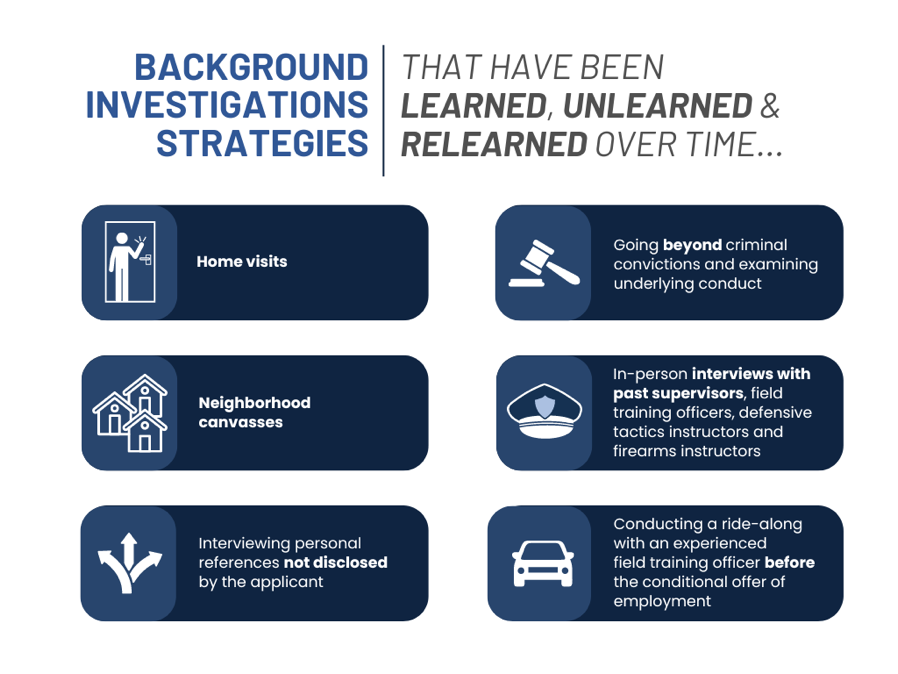
The real work for background investigators, which must be done before approving a candidate, requires an out-of-office-experience. Technological advancements have not replaced traditional methods including, but not limited to, a home visit, neighborhood canvass, and interviews with past supervisors, FTOs, and firearms instructors.

Law enforcement leaders should be prepared to defend their hiring practices by describing their efforts, outside of minimal in-office background checks, to identify possible character, integrity, and competence issues revealed by past conduct. This is particularly true in light of the financial and public trust costs associated with bad hires, when compared to the costs associated with a thorough background investigation. 


About the Author

Matt Dolan, J.D.

Matt Dolan is a licensed attorney who specializes in training and advising public safety agencies in matters of legal liability, risk management, and ethical leadership.  His training focuses on helping agency leaders create ethically and legally sound policies, procedures, and practices as a proactive means of minimizing liability and maximizing agency effectiveness. 

A member of a law enforcement family dating back three generations, he serves as both Director and Public Safety Instructor with Dolan Consulting Group.

In December of 2024, he published his first book, Police Liability: A Guide for Law Enforcement Leaders of All Ranks.

His training courses include Background Investigations in Law Enforcement, Supervisor Liability for Law Enforcement, and Internal Affairs: Legal Liability and Best Practices.


Disclaimer: This article is not intended to constitute legal advice on a specific case.  The information herein is presented for informational purposes only.  Individual legal cases should be referred to proper legal counsel.


References
_____________________________________________

[1] Jonah Owen Lamb and Garrett Leahy, “Rookie cop fired after high-speed DUI crash,” San Francisco Standard, May 20, 2025. Accessed December 19, 2025 at: https://sfstandard.com/2025/05/20/rookie-cop-fired-after-high-speed-dui-crash/

[2] Gino DeAngelis, “Probationary Providence Police officer arrested on multiple narcotics charges,” ABC 6 Providence News, June 27, 2025. Accessed December 17, 2025 at: https://www.abc6.com/probationary-providence-police-officer-arrested-on-multiple-narcotics-charges/

[3] Dan Raby and Aungelique Proctor, “Atlanta police recruits dismissed after altercation at East Point business, officials say,” Fox 5 Atlanta News, July 24, 2025. Accessed December 19, 2025 at: https://www.fox5atlanta.com/news/atlanta-police-recruits-dismissed-altercation-east-point-business

[4] Melissa Andrews and Brian Dugger, “Fired Walbridge police officer previously resigned from Toledo after 3 separate incidents involving alcohol, records show,” WTOL 11 News, September 24, 2025. Accessed December 19, 2025 at: https://www.wtol.com/article/news/investigations/11-investigates/fired-walbridge-officer-resigned-toledo-alcohol-incidents-ervin/512-7d1839e5-4bcb-4352-a8cb-8d4560b44466

[5] Ibid.

[6] Dillon Collier and Joshua Saunders, “SAPD probationary officers fired after drunken incident days apart,” KSAT News, November 24, 2025. Accessed December 26 at: https://www.ksat.com/news/ksat-investigates/2025/11/24/sapd-probationary-officers-fired-after-drunken-incidents-days-apart/

[7] Bureau of Justice Assistance and Office of Community Oriented Policing Services, Recruitment and Retention for the Modern Law Enforcement Agency: Revised (Washington, DC: Office of Community Oriented Policing Services, 2023).

[8] BJA and COPS, Recruitment and Retention for the Modern Law Enforcement Agency, 4.

[9] NBC Chicago, “Here’s What to Know About Illinois’ SAFE-T Act and the NEW Changes Coming,” NBC Chicago News, December 2, 2024. Accessed December 23, 2024 at: https://www.nbcchicago.com/news/local/heres-what-to-know-about-illinois-safe-t-act-and-the-new-changes-coming/3011535/

[10] Sangamon County Sheriff’s Office Press Release, “Illinois State Police Announce Investigation into Officer Involved Shooting Continues,” Sangamon County Sheriff’s Office, July 10, 2024: Accessed on December 30, 2024 at: https://sangamonil.gov/departments/s-z/sheriff/sonya-massey-information#:~:text=On%20July%206%2C%202024%20at,deceased%20at%20an%20area%20hospital.

[11] Danny Connolly, “Sheriff Campbell Planning Policy Changes After Deputy Shooting of Sonya Massey,” WCIA News, August 1, 2024. Accessed December 23, 2024 at: https://www.wcia.com/news/sheriff-campbell-planning-policy-changes-after-deputy-shooting-of-sonya-massey/

[12] Janelle Griffith, “$10 million settlement in Sonya Massey shooting case gets final approval,” NBC News, February 12, 2025. Accessed December 19, 2025 at: https://www.nbcnews.com/news/us-news/10-million-settlement-sonya-massey-shooting-case-gets-final-approval-rcna191825

Minimizing Liability WITHOUT Forgetting the Mission in Law Enforcement

It is vital to agency operations that police leaders continuously consider the ramifications of their leadership decisions in the context of liability and risk management. Lawsuits alleging officer misconduct bring with them financial costs, organizational stress, and potential damage in the court of public opinion. But law enforcement is, by its very nature, a high risk and high liability profession. Unfortunately, some of the easiest ways to limit liability are often found in de-policing or a “no contact, no complaint” approach to policing that undermines a law enforcement agency’s core mission. It is critical that police leaders pursue a balanced and thoughtful approach to liability without sacrificing proactive policing strategies that make communities safer.

The first principle of law enforcement, articulated in 1829 by Sir Robert Peel, the founder of modern policing, asserts that the role of the police is to prevent crime and disorder.[i] A failure to follow this guiding principle, in the name of limiting liability by any possible means, poses a fundamental threat to police operations, officer morale, and public trust.

Conversations about police misconduct and police liability tend to be overwhelmingly focused on instances of what could best be described as sins of commission. These sins of commission typically involve allegations of excessive use of force, racial targeting, unlawful search and seizure, and other violations of citizens’ rights by way of unlawful police action. The focus on this type of police misconduct is understandable, as these cases tend to result in the largest financial liability and violate a very American sense that citizens should generally be left alone by government officials as they go about their daily lives.

But what is often overlooked in conversations regarding police misconduct and police liability are sins of omission. In an era when de-policing, disengagement, and a “no contact, no complaint” mentality are so pervasive in too many departments, police leaders should feel compelled to be vigilant for this type of misconduct. 

In the book Emotional Survival for Law Enforcement, Dr. Kevin Gilmartin describes this phenomenon and largely attributes it to a victim mentality adopted by officers frustrated by the stresses of police work. Gilmartin writes, “Good officers do not show their victim status by going out and doing something wrong. They go out and stop doing something right.”[ii] Gilmartin further illustrates this damaging mindset by articulating the common refrain of disengaged officers: “You never get in trouble for the stop you don’t make.”[iii] Without a doubt, this mentality is often adopted with the unconscious assistance of agency leaders who fail to give cops on patrol a clear sense of the rules of engagement to be followed when encountering crime and disorder in the field. The need to clarify the rules of engagement and recognize successful proactive police work is painfully clear.

Many police leaders, elected officials, and commentators like Heather Mac Donald, justifiably point out that placing officers in situations where they are genuinely at a loss as to what is expected of them is bound to have dangerous effects in favor of de-policing.[iv] In too many agencies across the country, the concerning lack of clear rules of engagement can turn into demoralization and devolve into the adoption of a victim mentality for officers, which can manifest itself in the form of a staggering degree of disengagement that police leaders cannot ignore.

In particularly egregious cases, sins of omission in law enforcement may do just as much damage to public trust as sins of commission, even if the likelihood of financial liability may not be as significant. Furthermore, at their worst, cases of police inaction in the face of the public’s call for help may prove to be the most effective argument for defunding the police that has ever been formulated. After all, it is predictable that members of the public will ask: if more cops just means more people putting up tape and passing the time during a shift, what’s the point of more cops?

But it must be possible to emphasize minimizing liability without falling into an over-emphasis on avoiding legal liability at all costs. This may seem like a strange point to be made by an attorney who focuses his work on helping police leaders to address liability risks, but hopefully my position underscores its importance.

Legal liability should be minimized, it should be managed, and it should serve as a necessary “wake up call” in cases of leadership failures within a department. However, the idea that the goal is to never get sued and never incur legal liability in a line of work as chaotic, complicated, and hazardous as law enforcement is unrealistic and potentially dangerous insofar as it punishes proactive policing strategies.

If the only goal is to avoid legal liability, there is an unethical and self-destructive pathway that some may take: they may just stop doing police work. Traffic stops, Terry stops, and all other forms of proactive policing carry with them risks of lawsuits. But the true costs of police misconduct and negligence are much more about the costs to society than the costs incurred financially for police departments, cities, counties, or states.  

The police alone cannot improve society, but society cannot be improved without the police. As former NYPD police commissioner Bill Bratton once noted: “I can’t solve the unemployment problem, the school problem. But if I can create safety, then companies will invest, jobs will be created, schools might be improved. We can’t do it all alone, but it can’t be done without us.”[v] We can see plainly what happens to a neighborhood or a city that is unsafe. Political arguments about tax policy and education policy and zoning are important, but if people don’t feel safe, they will move to other communities or, in the case of the extremely wealthy, they will hire their own private police that the rest of us could never afford.

It seems clear that there are two distinct paths that will take law enforcement agencies and their communities toward two distinctly different futures in the coming years. One is focused on de-policing and defensive police strategies. This path may result in fewer allegations of discrimination, wrongdoing, and police negligence, but it will just as likely result in more crime and disorder. 

The other path is focused on proactive policing strategies that are ethically and legally defensible, in keeping with the Constitution, and are always evolving with the needs and concerns of the people who rely on the police. This path may result in more lawsuits than anyone would like to deal with, and an ongoing process of learning and improving agency operations accordingly. But this path will also result in a level of safety which allows people to go about their days and plan for their futures without the constant threat of crime. I would encourage any law enforcement leader who reads this article to choose this second, ethically defensible path.


About the Author

Matt Dolan, J.D.

Matt Dolan is a licensed attorney who specializes in training and advising public safety agencies in matters of legal liability, risk management, and ethical leadership.  His training focuses on helping agency leaders create ethically and legally sound policies and procedures as a proactive means of minimizing liability and maximizing agency effectiveness.  


A member of a law enforcement family dating back three generations, he serves as both Director and an instructor with Dolan Consulting Group. He has trained thousands of law enforcement professionals over the last decade.

In December of 2024, he published his first book, Police Liability: A Guide for Law Enforcement Leaders of All Ranks.

His training courses include Internal Affairs Investigations: Legal Liability and Best Practices, Supervisor Liability for Law Enforcement, Recruiting and Hiring for Law EnforcementConfronting the Toxic OfficerPerformance Evaluations for Public Safety, and Confronting Bias in Law Enforcement.


Disclaimer: This article is not intended to constitute legal advice on a specific case.  The information herein is presented for informational purposes only.  Individual legal cases should be referred to proper legal counsel.


References

[i] John Dempsey and Linda Forst. An Introduction to Policing (Belmont, CA: Thompson-Wadsworth, 2008), 7.

[ii] Kevin M. Gilmartin, Emotional Survival for Law Enforcement (ES Publishing, 2002), 102.

[iii] Ibid.

[iv] Heather Mac Donald, The War on Cops: How the New Attack on Law and Order Makes Everyone Less Safe. (Encounter Books, 2017), 65. 

[v] John H. Richardson, “What I’ve Learned: NYPD Commissioner Bill Bratton,” Esquire, September 10, 2016. Accessed May 13, 2024 at: https://www.esquire.com/news-politics/a32470/bill-bratton-0315/.

Officer Burnout and Legal Liability

For many law enforcement agencies, summer represents an increase in call volumes, violent crime, public events, and other factors that place significant strains on sworn officers in the face of increasing public demands. This may be an ideal time to discuss the risks associated with officer burnout that result from too many hours worked without rest. 

While agencies may continually increase the financial incentives that entice officers to go without enough sleep or rest, and police leaders may be tempted to ignore the obvious exhaustion being exhibited by officers, eventually, officers will show signs of mental, physical, and emotional fatigue. This fatigue will impact their family lives and their work. The only question is how severe the impact will be and how long it will take for the “wear and tear” to become apparent.

Officer burnout is clearly a matter of officer health, officer retention, operational effectiveness, and public trust. Requiring exhausted officers to make split-second decisions regarding appropriate use of force, while engaging with the most difficult people in highly stressful situations, is a recipe for disaster in the court of law and the court of public opinion.

If all of the aforementioned issues prove insufficient to convince law enforcement leaders and elected officials to re-evaluate their deployment strategies in light of officer burnout, there is an additional consideration. There are legal liability risks associated with sleep deprived and overworked officers. Oftentimes, when appeals to officer health fall short of effectively “moving the needle,” the looming threat of legal fallout may be more effective in producing changes, as unfortunate as that might be.

In May of 2019, as the Minneapolis Police Department grappled with the reality of excessive overtime and exhausted MPD officers, a criminal justice professor at John Jay College of Criminal Justice named Dennis Kenney offered the Minneapolis Star Tribune a very straightforward articulation of the issue of exhaustion among law enforcement officers. Based on his research with law enforcement officers, he indicated that fatigue produces a physiological response. Fatigue results in less attention and less focus. Hand-to-eye coordination begins to diminish as fatigue increases, and anger surfaces more rapidly. Kenney stated, “As I tell students: ‘I can work tired, I’m just not nice when I do it.’”[i]

While publicly denying that there was any connection between officer fatigue and poor decision making by officers, the public discussion of officer fatigue actually came on the heels of the City of Minneapolis having settled in the amount of $20 Million in a negligent fatal shooting case involving Officer Mohamed Noor. Officer Noor had worked a seven-hour shift at an off-duty assignment before beginning the MPD shift during which he would inexplicably shoot and kill a woman who had called 911 for assistance. The woman he shot and killed, whose family filed the lawsuit, was standing outside her residence in her pajamas when the squad car approached her. She was shot and killed by Officer Noor, who fired from the passenger side of the squad car, within moments of the officers’ arrival.[ii]

In discussing the department’s failure to account for hours worked in relation to agency policies limiting off-duty hours, Minneapolis Mayor Jacob Frey concluded, “If we can’t track hours worked, that’s not good.”[iii]

It is striking to realize that the Minneapolis Police Department, the flash point agency for debates surrounding police misconduct and police reform over the last four years, was publicly grappling with the issue of officer burnout in the months and years leading up to the in-custody death of George Floyd, and the subsequent fall out that continues to this day.


Officer Supply and Public Demand

The challenge of maintaining adequate staffing levels, which impacts officer time off, has been another issue facing police leaders in recent years. In August 2023, the Police Executive Research Forum (PERF) published a report on the state of police staffing in the United States. PERF compiled some of the most comprehensive statistics regarding police recruiting, staffing, and retention, based on its surveys of law enforcement agencies across the country. Based on PERF’s survey of over one-hundred law enforcement agencies across the country, its findings indicated that officer staffing levels fell by 4.8% overall between January of 2020 and January of 2023, fueled by substantial increases in both resignations and retirements.[1]

These statistics are not surprising, given the nationwide trend of reported struggles in recruiting, retention, and staffing by law enforcement agencies. These statistics are also consistent with the thousands of exchanges that I have had with police leaders in recent years in which they express increased struggles in reaching and maintaining authorized staffing levels of sworn officers. 

News accounts of cities in desperate need of more law enforcement man-hours are abundant. The decades of declining U.S. birth rates, and the current labor shortages across all professions, suggest that the overwhelming demand for more officers will not subside anytime soon. 

As a result of these circumstances, agencies across the country saw explosions in police overtime spending in 2023. Portland, Oregon officers were offered double overtime to fill vacant shifts.[2] In Philadelphia, police officer overtime increased by 36% in the face of a staffing shortfall.[3] The Kalamazoo County Sheriff’s Office in Michigan reported the highest rates of mandatory overtime in recent history.[4] The Spokane Police Department’s overtime budget grew by 50%, year over year.[5] Chicago’s police superintendent sought to “rein in” overtime spending, which had reached levels far in excess of $200 million after multiple years.[6]

These financial assessments of the costs of police overtime do not calculate, however, the human toll on officers and their families, and the liability risks created by allowing or mandating staggering amounts of overtime and/or off-duty work. We will never be able to precisely calculate how many costly and career-ending decisions by officers were significantly impacted by officer burnout in the form of excessive hours worked, lack of sleep and rest, and inadequate opportunities for quality family time. Only time will tell how many plaintiff attorneys will seek to use the fact that officers were permitted or mandated to work excessive hours as a source of agency liability in cases of alleged misconduct or negligence in the years ahead.

In Chicago, in the summer of 2022, several aldermen moved to pass legislation affirming Chicago police officers’ rights to days off, barring emergencies. This came in the wake of three CPD officer suicides in one month, and 20 officer suicides in three years.[7] Shortly thereafter, the Chicago Police Department instituted a new policy under which officers could have no more than one day of requested days-off canceled in a single week, with the exception of holidays. Then-mayor Lori Lightfoot commented that, “tired, emotionally wrought officers is not good for them, not good for their families, and not good, frankly, for the community members that they’re serving.”[8]

The case of Chicago in 2022 is a sadly common one. Issues surrounding officer burnout and mental health are addressed, if at all, only after a surge in officer suicides. Police leaders and elected officials owe it to their officers and their communities to be honest about the human limitations within which they must operate when it comes to officer hours worked. Part of that conversation should involve a recognition that various mental health resources, as valuable as they are, cannot undo the damage often done to officers’ mental and physical health as a result of excessive work and time away from their families.   

It should be sufficient to simply argue to elected officials and other decision-makers that officer burnout is a threat to the well-being of the men and women in their law enforcement agencies. Unfortunately, it sometimes seems that only the specter of liability may be the factor that motivates many of those decision-makers to approach this issue with the seriousness that it deserves.


Voluntary Overtime Policies—Protecting Our People from Themselves

Many agencies have worked to move from mandatory overtime to voluntary overtime, but this change does not necessarily solve the problem. First, there is a strong argument to be made that financially-stressed officers should not have the option to work excessive overtime—whether for the department or for an outside entity in the form of off-duty work. This is because doing so would pose liability and safety risks to themselves and the public. Secondly, even when limits exist in policy, time and time again, agency leaders have failed to adequately monitor overtime hours worked by officers to ensure that the policies limiting work hours are adhered to.

As mentioned above, in the months before the in-custody death of George Floyd, one of the areas of mismanagement that Minneapolis Police and city leaders were seeking to address was the issue of officer exhaustion in a system where hours worked were simply not tracked. 

In addition to the inherent liability risks associated with excessive overtime, there is also an increased risk of officers engaging in unlawful overtime fraud when police leadership fails to diligently monitor hours worked, compare those hours to relevant policies, and ensure that the cops on the street know that their hours are being evaluated. Notable overtime scandals have emerged in the last three years that illustrate this fact in New Orleans, Baltimore and Albuquerque.[9]

As with so many critical areas of police operations and liability management, creating sound policies and procedures is often not the difficult part. Rather, the steady and mundane work of monitoring performance and conduct and ensuring that those well-crafted policies and procedures are followed, is the hard part. This is what separates highly professional agencies from dysfunctional ones. In the case of some of the agencies referenced above, the issue was not that the overtime and off-duty work policies and procedures were flawed, but that the ability and/or willingness of agency leadership to track hours worked was woefully lacking.

One final cause for serious concern in regard to voluntary excessive overtime work is brought to the forefront by asking the question: Who is most likely to put in for the most overtime? Is there a distinct possibility that the men and women experiencing the most serious financial strains, and the personal and family stress so often associated with those strains, are those volunteering for the most overtime? If this is so, it is highly plausible that an agency’s most vulnerable  officers are taking on greater risks for themselves and their agencies by working more and more. 


Conclusion

Consider the idea of officers working in a state of exhaustion in comparison to officers working under the influence of alcohol. In past generations of American law enforcement, the consumption of alcohol on duty was not taken nearly as seriously as it is now. With time, cultural shifts based on the growing appreciation of the dangers associated with alcohol consumption while engaged in dangerous and complex tasks have resulted in a current reality where such conduct would be shocking to the public, supervisors, and rank-and-file officers, alike. 

It is striking to think that the same police leaders who would never allow officers to work while under the influence of alcohol—shaking their heads in disbelief at generations past that allowed it—are now allowing, or even mandating, that troopers, deputies, and officers across the country work schedules that are so demanding and detrimental to their sleep and rest, that they might as well be operating at levels similar to legal intoxication. 

Is it possible that in one or two generations, police leaders will look back on this era in disbelief that cops were allowed to work, carrying guns and badges, and encountering stressful, often life and death situations, while being so low on sleep that they may as well have been drunk?


About the Author

Matt Dolan, J.D.

Matt Dolan is a licensed attorney who specializes in training and advising public safety agencies in matters of legal liability, risk management and ethical leadership.  His training focuses on helping agency leaders create ethically and legally sound policies and procedures as a proactive means of minimizing liability and maximizing agency effectiveness.  

A member of a law enforcement family dating back three generations, he serves as both Director and an instructor with Dolan Consulting Group. He has trained thousands of law enforcement professionals over the last decade.

His training courses include Internal Affairs Investigations: Legal Liability and Best Practices, Supervisor Liability for Law Enforcement, Recruiting and Hiring for Law EnforcementConfronting the Toxic OfficerPerformance Evaluations for Public Safety and Confronting Bias in Law Enforcement.

Disclaimer: This article is not intended to constitute legal advice on a specific case.  The information herein is presented for informational purposes only.  Individual legal cases should be referred to proper legal counsel.


References


[1] Police Executive Research Forum, Responding to the Staffing Crisis: Innovations in Recruitment and Retention (Washington, DC: Police Executive Research Forum, 2023). Accessed on April 5, 2024 at: https://www.policeforum.org/assets/RecruitmentRetention.pdf   

[2] John R. Ferrara, “PPB Offering Officers Double Overtime to Fill Vacant Shifts Amid Staffing Crisis,” KOIN CBS Portland News, August 16, 2023. Accessed on April 5, 2024 at: https://www.koin.com/news/portland/ppb-offering-officers-double-overtime-to-fill-vacant-shifts-amid-staffing-crisis/amp/

[3] Anna Orso, “Philadelphia is Spending a Record Amount on Overtime as 1 in 5 City Jobs Sits Vacant,” Philadelphia Inquirer, July 5, 2023. Accessed on April 5, 2024 at: https://www.inquirer.com/politics/philadelphia/philadelphia-record-overtime-short-staffing-police-20230705.html   

[4] Ron French, “Michigan Police Shortage Becoming Dire: Where Did Everyone Go?” The Bridge: The Bridgeman, Michigan Newspaper, July 2, 2023. Accessed on April 6, 2024 at: https://www.bridgemi.com/michigan-government/michigans-police-officer-shortage-becoming-dire-where-did-everyone-go

[5] Emry Dinman, “Spokane Police Overtime Budget Nearly Doubled in 2023: It Won’t Be Nearly Enough,” The Spokesman Review, June 28, 2023. Accessed on April 6, 2024 at: https://www.spokesman.com/stories/2023/jun/28/spokane-police-overtime-budget-nearly-doubled-in-2/

[6] Heather Cherone, “Chicago’s Top Cop Vows to Rein in Police Overtime Spending as 2023 Bill Tops $200M,” WTTW NPR News, October 0, 202. Accessed on April 6, 2024 at: https://news.wttw.com/2023/10/30/chicago-s-top-cop-vows-rein-police-overtime-spending-2023-bill-tops-200m

[7] Fran Spielman and Tom Schuba, “Chicago Police Officers Could Decline Excessive Overtime Hours Under Proposed Ordinance,” Chicago Fox 32 News, July 20, 2022. Accessed on April 7, 2024 at: https://www.fox32chicago.com/news/chicago-police-officers-could-decline-excessive-overtime-hours-under-proposed-ordinance

[8] Charlie De Mar, “CPD Makes Change After Scathing Report on Cancellation of Officers’ Days Off,” CBS Chicago Channel 2 News, August 30, 2022. Accessed on April 7, 2023 at: https://www.cbsnews.com/chicago/news/cpd-makes-change-after-scathing-report-on-cancellation-of-officers-off-days/   

[9] John Simerman, “26 New Orleans Police Officers Suspended from Off-Duty Security Work Amid Investigation,” NOLA.com, November 18, 2021. Accessed on April 8, 2024 at: https://www.nola.com/news/crime_police/26-new-orleans-police-officers-suspended-from-off-duty-security-work-amid-investigation/article_314863d6-48ca-11ec-a62e-fb326a0266e7.html; Associated Press, “Baltimore School Police Officer Indicted on Overtime Fraud Charges,” Associated Press, September 8, 2023. Accessed on April 8, 2024 at: https://apnews.com/article/baltimore-school-police-officer-overtime-fraud-1ec8484ed1069fc6aa5274514ca22495; Larry Barker, “‘Worst I’ve Seen’: APD Overtime Scandal Uncovered,” KRQE News, March 15, 2022. Accessed on April 8, 2024 at: https://www.krqe.com/news/larry-barker/worst-ive-seen-apd-overtime-scandal-uncovered/      

What Cops Can Learn from Mother Teresa


The officer morale issues plaguing law enforcement agencies across the country in recent years have been well-documented.  Rank-and-file officers, and those tasked with leading them, often experience a profound sense of futility in the face of the addiction, mental health issues, homelessness and criminality that cops face every day.  The challenges that they face in their work, and the lack of meaningful political support, are likely unprecedented in the history of American policing.  So, what model should law enforcement professionals look to, as they struggle to muster the fortitude to continue to do their jobs each day?  What about a model from outside of the policing profession?

Mother Teresa (1910-1997) was an Albanian-born Catholic nun who became famous for founding missions of charity, primarily in Calcutta, India.  Her missionary work focused on the sick, the poor, the disabled, the widowed and the orphaned.  Her religious order grew to include over 4,500 nuns across 133 countries.  Although Mother Teresa did not carry a gun or a badge, she nonetheless represents the kind of steadfast commitment to doing good that cops desperately need today.  Her life and work can act as a model to those in the policing profession who are searching for inspiration to combat a sense of futility.  The five-foot-tall nun, who spent most of her life in city slums, was admired throughout India and the rest of the world during her lifetime for her works of charity, selflessness and compassion.  Her legacy, solidified by her canonization as a saint by the Catholic Church in 2016, continues to inspire countless people, both Catholic and non-Catholic.

Mother Teresa felt called to serve in the slums of Calcutta precisely because it was a place of hopelessness.  She felt called to serve the poorest of the poor and the most hopeless of the hopeless.  She did it for half a century, and amazingly, she did it joyfully.  So, what can cops serving in 2023 learn from her example? 

Accept Your Limitations

Any veteran cop, jaded by years of experiencing society at its worst, might sum Mother Teresa’s life up in a more pessimistic way.  In a way that cuts to the core of the sense of futility that many officers so often experience, they might say, “When she went to the Calcutta slums, it was a hole.  She was there for 50 years, and when she died, it was still a hole.”

By most objective measures, this sentiment seems reasonable.  At the time of her canonization in 2016, the former mayor of Calcutta, who criticized her work, claimed, “she had no significant impact on the poor of this city.” [i]  No significant impact.  If we are critical enough and cynical enough, we can also make the same assessment of any cop.  Look at the crime statistics in any jurisdiction and you can easily conclude that the men and women who have served as cops there have utterly failed for generations.  Never once has there been a law enforcement officer’s retirement ceremony, during which it was honestly claimed that the retiring cop ended crime, disorder and useless suffering in the town, city, county or state.  No matter how much good work the officer did, eventually there were new victims, new crimes and new gangs.  So, what was the point?  What was the point?

Once, when asked if she and the sisters she worked with were able to accomplish all that they would like, Mother Teresa did not sugar-coat the reality of her limitations.  “Unfortunately, the needs are always greater than our ability to meet them.”[ii]  That frank and honest assessment is also applicable to law enforcement officers and agencies who see the high volume of calls for service and need for proactive enforcement activities, compared to their staffing levels.

Mother Teresa also warned against a stats-driven outlook so familiar to those in law enforcement: “Never worry about numbers.  Help one person at a time, and always start with the person nearest you.”[iii]

It is important to note that she was not naive to the enormity of the tasks before her.  Rather, she accepted them and kept pushing forward without the naive hope that she and her fellow nuns would somehow put an end to pain, poverty and suffering.  Without ignoring the brutal realities of life and of her work, she refrained from focusing on the whole system instead of focusing on what can be accomplished today—one person at a time.  She accepted her limitations and worked in spite of them.

Help the Person in Front of You

For someone like Mother Teresa, it seems that accepting her own limitations was an important precursor to throwing herself into what can be accomplished, instead of focusing on what cannot“I never think in terms of crowds in general, but in terms of persons.  Were I to think about crowds, I would never begin anything.  It is the person that matters.  I believe in person-to-person encounters.”[iv]

How many law enforcement officers have had an immeasurable impact on a person’s life because of something they did in the line of duty?  And yet, as genuinely inspiring as many of those individual stories may be, their actions inevitably did not result in putting a permanent end to crime and disorder in a community, let alone an entire city or county.  If the focus is on eliminating crime entirely, rather than what positive impact can be made in each and every encounter, disillusionment and burnout are nearly guaranteed.  Much more is accomplished, Mother Teresa asserted, if the focus is on the person-to-person encounters.

In the spirit of humility that defines a saint, Mother Teresa reminds us that we cannot possibly know the impact that our efforts will ultimately have on people’s lives: “I alone cannot change the world, but I can cast a stone across the waters to create many ripples.”[v]  Law enforcement officers who regularly encounter a toxic mix of societal ills could benefit from adopting this mindset for making an impact.

Mother Teresa also spoke to the leadership crisis that many experience within their agencies and see in their local elected officials.  Some cops grapple with constant frustration that the chief, the prosecutor, or any other number of individuals in leadership positions refuse to lead because doing so is too politically risky.  To people in situations like the ones these officers face, Mother Teresa said, “Do not wait for leaders; do it alone, person to person.”[vi]

Always Remember Your WHY

A sense of purpose—or lack thereof—may be the most significant factor in the outcome of individual and organizational endeavors.  This is not a new concept.  In fact, motivational author Simon Sinek recently wrote a book on the subject from a broader secular perspective than anything professed by a saint like Mother Teresa.[vii]  But the need for consistent reminders on the importance of purpose only indicates how universally true it proves to be.

If the why, or the purpose, is to solve all of the world’s problems, then we have created a sure-fire path to the frustration and disillusionment that is all too prevalent among law enforcement officers.  Mother Teresa’s why was not to solve the world’s problems.  It would seem impossible to make sense of her life—starting with decades of work in the slums of Calcutta before the world began taking notice of her—without understanding why she did it.  Her why is what drove her in the face of insurmountable societal ills and heartbreaking suffering that she knew she could never eradicate.

When asked about the constant difficulties in carrying out her work, she once responded, “Of course it would not be easy without an intense life of prayer and a spirit of sacrifice.”[viii]  As expected for a nun who felt called by Christ at a young age to serve the Church, Mother Teresa’s Catholic faith was the driving why behind everything that she did in her life.  Daily prayer and daily Mass were ways in which she continually reminded herself of her why

Your why, as a cop, does not have to be the same as Mother Teresa’s.  You don’t have to share her Catholic faith, or in any religion for that matter.  But you do have to possess a why that is more important than stats, and it must not be the doomed goal of eliminating crime and disorder entirely.  You should know your why and remind yourself, and those around you, of that purpose as often as possible to keep it firmly in the forefront of your mind.

There are many admirable role models in the realm of law enforcement that we can look to for inspiration in discussing the challenges facing law enforcement officers in 2023.  But since the challenges are indeed unprecedented, we may want to look beyond the profession for role models who have more in common with today’s cops than we would have thought.  Mother Teresa is a good start, as she shows us the importance of accepting our limitations, helping the person in front of us and remembering our why.


About the Author

Matt Dolan, J.D.

Matt Dolan is a licensed attorney who specializes in training and advising public safety agencies in matters of legal liability, risk management and ethical leadership.  His training focuses on helping agency leaders create ethically and legally sound policies and procedures as a proactive means of minimizing liability and maximizing agency effectiveness.  

A member of a law enforcement family dating back three generations, he serves as both Director and Public Safety Instructor with Dolan Consulting Group. 

His training courses include Internal Affairs Investigations: Legal Liability and Best Practices, Supervisor Liability for Law Enforcement, Recruiting and Hiring for Law EnforcementConfronting the Toxic OfficerPerformance Evaluations for Public SafetyMaking Discipline Stick®, and Confronting Bias in Law Enforcement.

References

[i] Bengali, Shashank. “Was Mother Teresa a saint?  In city she made synonymous with suffering, a renewed debate over her legacy” The Los Angeles Times, September 2, 2016.  Accessed: https://www.latimes.com/world/la-fg-india-mother-teresa-snap-story.html

[ii] Sri, Edward. No Greater Love: A Biblical Walk through Christ’s Passion. West Chester, PA: Ascension Press, 2019, p. 164.

[iii] Sanders, Alice. Mother Teresa: Greatest Life Lessons and Best Quotes. Seattle, WA: CreateSpace, 2015.

[iv] Sri, No Greater Love, p. 69.

[v] Sanders, Mother Teresa.

[vi] Ibid.

[vii] Sinek, Simon. Start with Why: How Great Leaders Inspire Everyone to Take Action. New York, NY: Portfolio, 2009. [1] Sri, No Greater Love, p. 163.

[viii] Sri, No Greater Love, p. 163.

Negligent Hiring Liability for Law Enforcement in 2023

Over a year ago, we at Dolan Consulting Group published an article entitled Negligent Hiring Liability for Law Enforcement in 2022.  Unfortunately, 14 months later, the cause for concern in this area has only grown.  More and more conversations we have with law enforcement leaders involve concerns about lowering standards in order to hire “warm bodies”, and more case studies are emerging.  Sadly, it seems that an updated article on this crucial topic is necessary.

Over the course of the last few years, and in the months ahead, law enforcement agencies have and will continue to struggle to fill vacant positions in an extremely difficult recruiting environment.  Beyond the labor shortage that appears to be impacting countless professions, from nursing to transportation to hospitality, law enforcement vacancies seem particularly difficult to fill.  This is the case, not only because of the rigors of the job, but also because of the sustained anti-police rhetoric which has dominated so much of popular culture in the last two years.  

Many of the agencies that were defunded only two or three years ago are now being tasked to pull a “U-Turn” and increase staff in the face of a surge in violent crime.  Confronted with pressures to hire officers as quickly as possible and generate recruit classes that are more diverse, leaders will inevitably face the temptation to cut corners and ignore red flags to get “boots on the ground”

These increasing pressures may regrettably mean that those boots are not filled with qualified men and women who demonstrate the character traits and competencies necessary to successfully serve their communities.  Making these short-term fixes even more appealing are their delayed consequences–bad hires may not become public safety, legal liability or public trust disasters for many months or even years.  Short-term thinking could motivate hiring decisions that will fill the ranks today, but make for negative headlines and lawsuits for years to come.

At this moment, the law enforcement profession, and the citizens who depend on it, need agency leaders and other key personnel to meet the ethical challenge of resisting the temptation to hire unqualified applicants.  In the long run, these applicants have the potential to inflict tremendous damage on agencies, the profession and the communities that these agencies serve. 

The last thing that officers and citizens need now is “warm bodies” hired into the law enforcement field who will ultimately bring disrepute to the profession, rather than further the mission to protect and serve.  By learning from the mistakes of the past, being wary of common hiring pitfalls and understanding the long-term impact of negligent hiring practices, agency leaders can uphold their integrity and that of the profession without contributing to the detriment of their agencies and communities.


What We’ve Seen Since the Start of 2022

In May of 2022, the mayor of San Jose, amidst what he described as a “drumbeat” of disturbing police misconduct cases, acknowledged that improved screening of new applicants was vital to addressing the personnel problems facing the San Jose Police Department.  Then-mayor Sam Liccardo, noting the prevalence of newer officers among those facing criminal and/or administrative charges, publicly stated his concerns surrounding screening protocol.  Mayor Liccardo asserted, “I expect and I know the department is looking into this right now and in the next several days, we’ll be able to identify the specific actionable steps the department will take to ensure that we don’t see news like this again.” [1]

In September of 2022, a Colorado officer parked his patrol car across train tracks and placed a handcuffed arrestee inside. Shortly after the arrestee was placed in his patrol car, a freight train struck the vehicle, causing severe injuries to the woman inside.  In October of 2022, local news outlets uncovered recent personnel files from his former department, including performance evaluations and Internal Affairs investigation findings.  These documents raised red flags concerning the officer’s competence and regard for officer and public safety.  Local media inquiries for comment were met with standard statements regarding background processes but did not speak to the past employment problems in question. [2]

In late October of 2022, a Maryland Sheriff’s deputy was arrested and charged with raping a woman while on duty and in uniform.  The deputy had been employed with the agency for less than one year.  In a media interview in early November of 2022, the Sheriff stated that, “[i]t’s very difficult to recruit good quality candidates…So what do we find ourselves doing? Hiring people that didn’t wow us during the interview.  But we need warm bodies on patrol still in these vacancies that we have within our agencies.  And inevitably, what does that do? It lowers our standards. This is how individuals are able to get through the cracks.” [3] 

In November of 2022, a newly-hired Virginia Sheriff’s deputy traveled to California and allegedly murdered a young woman he had met online, along with her parents, before killing himself with local police officers surrounding him.  In December of 2022, it became clear that the deputy had previously worked as a Virginia State Trooper—having been hired in spite of the apparent availability of a 2016 police report detailing a police encounter during which he was held for a psychiatric evaluation after threatening to kill himself and his father.  A Virginia State Police spokesperson indicated that “human error” was to blame for his hiring in 2021. [4]

And finally, in February of 2023, in the wake of Tyre Nichols’ death and the filing of criminal charges against several officers involved in his arrest, former members of the Memphis Police Department recruiting unit came forward with allegations that the MPD had lowered hiring standards in the years leading up to Nichols’ death.  One retired MPD lieutenant formerly in charge of recruiting claimed, “[t]hey would allow just pretty much anybody to be a police officer because they just want these numbers.” [5]


Going Beyond Automatic Disqualifiers 

An agency’s automatic disqualifiers, whether related to past criminal convictions, drug use or other clear “red flags”, are a vital part of the vetting process.  However, no compilation of automatic disqualifiers—no matter how well drafted—will render a thorough background investigation less important.  In a thorough background investigation, possible disqualifiers related to temperament and character will inevitably emerge that do not fit neatly into one of the automatic disqualifier categories.  Past supervisors, neighbors, family members and others are invaluable sources of information.  The insight they provide may not be in the form of a criminal conviction or even an arrest.  It may not point to prohibited drug use.  It may, however, reveal issues pertaining to anger management, mental health, substance abuse, trustworthiness or any other of a multitude of concerning character traits.

The fact that a candidate occupies the problem house or apartment in a community is relevant.  The fact that the police are called to the candidate’s residence on a regular basis in response to noise complaints is relevant.  The fact that multiple supervisors or personal references describe him or her as somehow prone to anger is relevant.  Even if none of these pieces of information are a part of the list of automatic disqualifiers, they are still relevant.

It seems likely that the over-reliance on automatic disqualifiers is born of an interest in speed and convenience.  Conducting home visits, canvassing neighborhoods and interviewing references all require significant time and effort.  Agency leaders are tempted to expedite the hiring process by focusing less on these fundamental investigative techniques.  As important as it is to process applicants quickly, neglecting these tried-and-true background investigation strategies may lead to missing critical pieces of information that do not show up on a criminal record or social media account. 


Hiring the Wrong People Today Makes It Harder to Recruit the Right People Tomorrow 

In 2023 and beyond, hiring decisions will be made that will profoundly impact the future of American policing.  Who will be our next generation of law enforcement officers?  Beyond the legal liability concerns related to negligent hiring, the societal costs are even greater.  

If agency leaders give in to the temptation to fill recruit classes hastily and short-sightedly in order to “hit their hiring numbers”, without due regard for the quality of the people being hired on, what is the predictable impact on the occurrence of police misconduct on and off the job?  If the past is repeated, and these hiring frenzies continue to result in unqualified individuals being hired, and in turn a rise in instances of misconduct, police recruiting will only become more challenging.

It has never been more difficult for law enforcement agencies to hide their problem people than it is today.  The odds of a bad hire becoming the face of the agency is greater than ever before.  Therefore, the legal, public safety and public trust costs of negligent hiring decisions have never been a greater risk.

For the generation of law enforcement leaders who will be retiring in the coming years, the most significant impact they will have on their agencies and their communities may be the role they play in vetting and hiring the next generation of officers who will answer the call long after they retire.  That may well be their legacy, for better or for worse.  


About the Author

Matt Dolan, J.D.

Matt Dolan is a licensed attorney who specializes in training and advising public safety agencies in matters of legal liability, risk management and ethical leadership.  His training focuses on helping agency leaders create ethically and legally sound policies and procedures as a proactive means of minimizing liability and maximizing agency effectiveness.  

A member of a law enforcement family dating back three generations, he serves as both Director and Public Safety Instructor with Dolan Consulting Group. 

His training courses include Internal Affairs Investigations: Legal Liability and Best Practices, Supervisor Liability for Law Enforcement, Recruiting and Hiring for Law EnforcementConfronting the Toxic OfficerPerformance Evaluations for Public SafetyMaking Discipline Stick®, and Confronting Bias in Law Enforcement.

Disclaimer: This article is not intended to constitute legal advice on a specific case.  The information herein is presented for informational purposes only.  Individual legal cases should be referred to proper legal counsel.


References


[1] Lin, Summer. “San Jose: Liccardo calls for improved screening, background checks after slew of police misconduct allegations: Police confirmed this week an officer is on leave over an allegation he traded a meth pipe for information.” The Mercury News, May 12, 2022. Accessed: https://www.mercurynews.com/2022/05/12/san-jose-liccardo-calls-for-improved-screening-background-checks-after-slew-of-police-misconduct-allegations/

[2] Maass, Brian. “Police officer who parked on train tracks called ‘incompetent’ by fellow officers, demotion recommended at previous department.” CBS Colorado, October 27, 2022. Accessed: https://www.cbsnews.com/colorado/news/platteville-police-officer-parked-train-tracks-called-incompetent-fellow-officers-demotion-recommended-sgt-pablo-vazquez/

[3] Wallace, Danielle. “Maryland cop arrested over in-custody Kohl’s lot rape allegedly had more victims, history of misconduct. At least 6 more women have come forward after the arrest of fired Wicomico County Sheriff’s Deputy Steven Abreu, who is accused of rape.” FOX News, November 7, 2022. Accessed: https://www.foxnews.com/us/maryland-cop-arrested-custody-kohls-lot-rape-allegedly-more-victims-history-misconduct

[4] WTVR CBS Channel 6 News. “’Human error’ made when Virginia State Police hired man now accused of murdering California family.” WTVR CBS Channel 6 News, December 7, 2022. Accessed: https://www.wtvr.com/news/local-news/human-error-austin-edwards-december-07-2022

[5] Condon, Bernard, Mustain, Jim, & Sainz, Adrian. “Amid soaring crime, Memphis cops lowered the bar for hiring.” Associated Press, February 7, 2023. Accessed: https://apnews.com/article/law-enforcement-tyre-nichols-memphis-crime-93033874b99a4893c6c996fd56676795


Sexual Harassment Liability in Public Safety

The national media has placed a keen focus on the issue of sexual harassment in the workplace over the past several weeks.  Media and political figures are accused of sexual misconduct and, possibly even more importantly, a multitude of men and women in positions of power are found to have been aware of misconduct to some extent but did little to prevent or report it.

As disturbing as these well-known cases are, the steady flow of accusations against some in public safety are, in many respects, more concerning.  Not because police officers or firefighters are routinely engaging in some of the types of misconduct reported out of Hollywood, but because the men and women of public safety are expected to uphold higher standards than celebrities and media moguls

First responders are the people we call in our moments of greatest need.  They enter private homes.  They are placed in the position to care for some of society’s most vulnerable individuals, including children, the elderly and countless victims of crime or medical emergency.

A working knowledge of their responsibilities in the area of harassment allegations is too often missing from the “tool box” of new supervisors as well as seasoned public safety leaders.  There are a few key items for agency leaders to keep in mind.

(1) Utilize common sense rules of thumb. Does an individual have a widely-known nickname that indicates a tendency to engage in harassing behavior?  Is a questionable activity in the agency widely-known by a nickname?  Is the only possible defense to what happened fall along the lines of: she initiated it, she was laughing as hard as anybody, he smiled through the whole thing?

All of these aforementioned examples illustrate that the activity is not a secret and is known to supervisors.  As a result, the agency is in no position to deny that they were alerted of the issue.  Behavior that would rightly embarrass the agency is known to the public does not need to be reported if the chief, captain or sergeant is already aware of it.

(2) Prohibit retaliatory acts in the wake of complaints. Leaders in public safety, through policy and training, need to emphasize to all supervisors the importance of avoiding retaliatory acts when harassment allegations are lodged.  It is vital that a person does not see shift or work assignments affected in any negative way due to simply lodging a complaint.  Even the appearance of retaliation, when some negative employment action is taken following closely behind a complaint, can often be the most costly part of a sexual harassment lawsuit in terms of finances and time.

(3) Reserve judgment when conducting the internal investigation. This is challenging in any internal investigation but particularly so as allegations become more egregious and personal—as in the case of sexual harassment cases.  Keep in mind that just because the accuser is not someone who you hold in high regard—personally or professionally—does not mean that the allegation is necessarily false.  Furthermore, just because the accused is someone you believe to be a great professional who you would never suspect of engaging in wrongdoing does not necessarily mean that they did not engage in the alleged behavior. 

Allowing preconceived notions about agency “superstars” or agency “trouble-makers” to impact the internal investigation can be disastrous
in that it stands to compromise the integrity of the investigation and puts the agency at substantial risk of liability stemming from the original complaint and/or allegations of subsequent retaliation.

(4) Demonstrate a willingness to take disciplinary action when allegations are shown to be demonstrably false. This is vitally important if agencies are going to gain genuine buy-in throughout the agency.  If there are allegations of sexual harassment in the agency—that should fundamentally trouble agency leaders for obvious reasons.  Those leaders should be equally bothered by false accusations against agency members.  For an employee to essentially “weaponize” laws created to protect workers in order to attack a fellow member of the department is unacceptable and it should prove a violation of agency policies prohibiting false reporting on fellow employees.

When investigating and evaluating harassment allegations, “never mind” from the complainant is never a reason to close the investigation.  If the investigation reveals that someone engaged in harassing behavior, that must result in serious disciplinary action.  The same is true if the investigation reveals that someone is falsifying allegations, regardless of the motive.  It is both possible and vital to agency operations that leaders treat harassing behavior and demonstrably false allegations of harassment with similar severity.

Contrary to their apparent belief, most Americans do not look to Hollywood or to Washington, D.C. for models of ethical conduct.  Many do, however, hold their local public safety professionals to high ethical standards.  This higher standard is reasonable and should be viewed as a public trust to be protected.

Sexual harassment liability poses a substantial risk to public safety agencies in terms of financial costs, organizational disruption and public trust.  It is vital to agency operations that all employees—and particularly supervisors—are familiar with their fundamental responsibilities under the law when it comes to sexual harassment.